
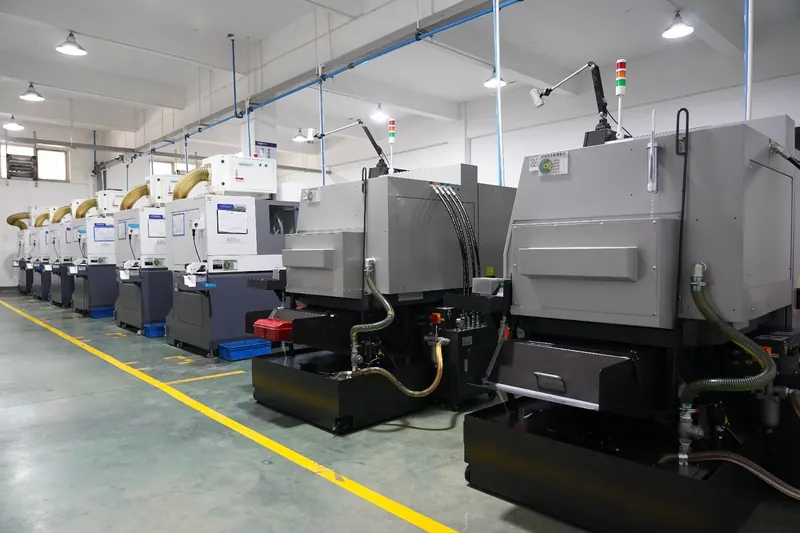
Choosing between Swiss turning and conventional CNC turning starts with how the workpiece is held during each cut. A machine name alone does not explain whether a long section stays supported, whether a shoulder blocks tool access, or whether another operation will still be needed.
For an OEM buyer, the useful outcome is a documented route for the complete part. Use the comparison below to ask better questions about support, feature access and acceptance. It is a drawing-review aid, not a rule that assigns every small component to a Swiss machine.
Swiss turning is a form of CNC turning
CNC describes numerical control of machine movements. Swiss-type turning commonly uses a sliding headstock: the spindle assembly holding the bar moves along its axis. In guide-bushing mode, the bar passes through a support close to the cutting zone. Conventional fixed-headstock turning keeps the headstock in place while the tools move to machine the workpiece. Citizen's automatic-lathe guide explains these constructions and why nearby support matters for slender work.
The distinction is therefore sliding-headstock versus fixed-headstock operation, with the actual support arrangement stated. It is not CNC versus a non-CNC process. Fixed-headstock machines may also use additional work support; the supplier should explain the setup proposed for the particular feature.
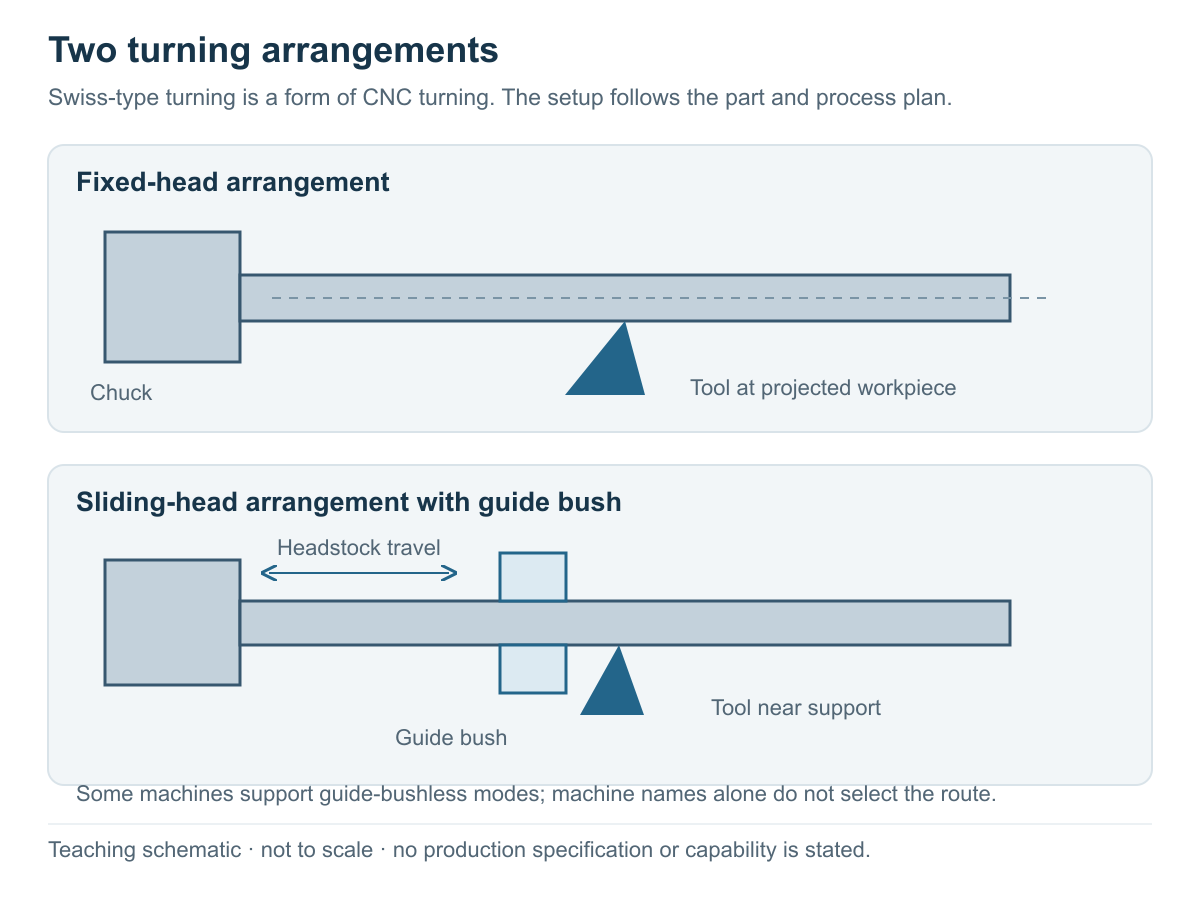
The diagram is a teaching illustration, not a layout of MICRO's machines. It does not assign machine capacities or achievable tolerances.
Check the configuration rather than relying on the label
Not every Swiss-type operation uses a guide bushing. Tsugami's product overview includes guide-bushless arrangements and different spindle configurations. Star's SP-20 specification lists guide-bushing and non-guide-bushing conversion. These examples establish that configurations vary; they do not identify equipment installed at MICRO.
That matters when a quotation says only “Swiss machining.” Ask which features will use guide-bushing support and how other features will be held. Likewise, a quotation describing a fixed-headstock route should explain any additional support or second setup needed. A general process category is not an inspection result.
A decision matrix for the drawing review
| What the drawing or order shows | Question worth asking | Evidence to request before approval |
|---|---|---|
| A long section with a small diameter | How close can support remain to the active cut? | Workholding and the critical section's machining sequence |
| A short, relatively rigid component | Does a fixed-headstock or guide-bushless route cover the features? | The proposed setup and additional operations |
| Several steps, grooves or flats | What access and support are available at each feature? | Features requiring transfer, regripping or a separate operation |
| Important relationships between opposite ends | How are those relationships preserved and checked? | The datum and inspection approach for the finished part |
| Heat treatment, coating or final grinding | At which stage are the requirements met? | The order of operations and specified inspection condition |
| Repeated orders with firm batch quantities | Which assumptions affect the quoted route? | Quantity basis, separate charges and route-specific exceptions |
Use the rows together. A slender section can favour close support while another feature complicates access. The supplier needs the complete drawing to resolve that combination.
Review support and feature access together
Start with the area being cut, not just overall length. Mark the sections where material removal leaves the least support, then identify the shoulders, grooves, flats and end features nearby. Ask how the proposed sequence keeps the part supported when each critical cut occurs.
Next, identify the relationships that must survive any transfer. For a stepped shaft, that may involve diameters and shoulder locations. A shaft with flats adds feature orientation to the discussion. These product pages illustrate shapes, not standard sizes or approved routes for your drawing.
A supplier may propose front and back machining, regripping, grinding or another operation. Ask which requirement each stage addresses. Do not assume that finishing a part in fewer setups automatically proves every relationship, or that a second operation makes a route unacceptable. The finished component still needs to satisfy the released requirements.
Keep the design requirement separate from a preferred machine type. If your purchase specification mandates a process, say so explicitly. Otherwise, ask the supplier to explain its recommendation and exceptions rather than forcing an equipment choice before reviewing the part.
Include stock, treatment and inspection in the comparison
A guide bushing interacts with the bar feeding through it, so the bar condition and selected bushing arrangement belong in the process review. Citizen describes adaptive guide-bush systems that compensate for bar-diameter variation. This is a machine-accessory example, not evidence that every Swiss setup accepts the same stock or that MICRO has that accessory.
Ask the supplier to confirm the proposed material grade and stock condition. Record any alternative that requires design approval. Avoid assuming that all Swiss work needs pre-ground bar or that a guide-bushless configuration is always the lower-cost choice.
Treatment and final finishing also belong in the route. If specified dimensions or surface requirements apply after treatment, the quote and inspection plan need to reflect that condition. Discuss surface requirements separately using the surface roughness and dimensional tolerance guide. A machine category does not define a part's Ra, size limits or geometric acceptance.
Worked review: a shaft with a shoulder, groove and flat
This is a hypothetical teaching example, not a customer case or a quotation. Consider a drawing containing a relatively slender stem, a shoulder, a circumferential groove and a flat near one end. No dimensions, alloy, tolerance or batch quantity have yet been assigned.
First, mark the stem as an area requiring a support discussion. Ask whether the proposed turning sequence can keep support close to the cut. Second, ask how the shoulder and groove affect access. Third, identify the flat's orientation and its relationship to the rest of the part. Finally, identify any final grinding or treatment required by the released design.
The result is a short review record: proposed route, unresolved requirement, proposed inspection and person responsible for the design decision. It is not an automatic choice of Swiss turning. A revised geometry or requirement could change the recommendation.
Apply the same questions to grooved shafts or other custom CNC turned parts. Compare the actual drawing features instead of treating a catalogue photograph as a process specification.
Compare a complete quotation, then qualify the agreed route
For a fair comparison, hold the drawing revision, material, finished condition, quantity and acceptance requirements constant. Ask both quotations to identify tooling or setup charges, excluded operations, inspection records and delivery assumptions. A unit price without that scope cannot establish which route is more economical.
There is no universal length-to-diameter threshold in this guide. There is also no promise that Swiss turning is always more accurate, cheaper or faster. The appropriate process depends on the part, workholding, equipment configuration and order requirements. Qualification should examine the resulting parts and records, not only the machine brand.
Where a sample stage is agreed, define the features and documentation to evaluate before releasing production. Use the sample approval guide to turn that review into an approval record rather than an informal “looks good” message.
Discuss the route with MICRO
MICRO's manufacturing information identifies CNC and Swiss-type turning, including Citizen and Tsugami machines, together with drawing-led process review. Grinding and other operations are selected as required by the part. That facility information does not establish a guaranteed tolerance, an installed model list or a route for every possible component.
Start with the RFQ checklist and include the current drawing, quantities and any mandated process. For shafts, the drawing-control guide helps distinguish the acceptance requirements from the machine choice. Review MICRO's inspection and documentation information before identifying the records needed for your project.
Request a drawing review and flag any open decisions. The website accepts an optional HTTPS drawing link; drawings can also be emailed to [email protected] with the inquiry reference. Engineering reviews the complete requirement before confirming a quotation and manufacturing proposal.