
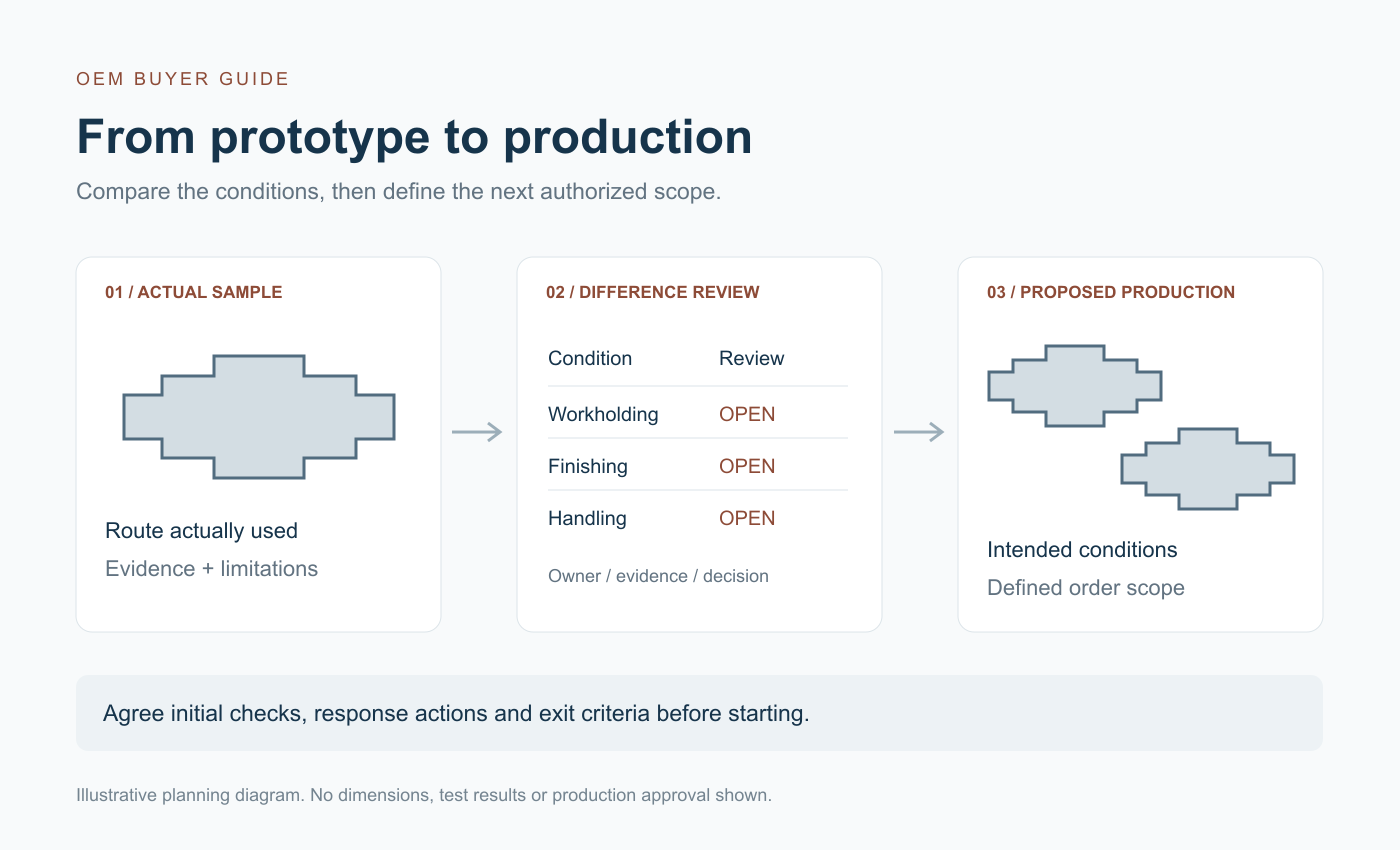
A prototype can fit the assembly and still leave important production questions unanswered. It may have been made with different workholding, extra manual finishing or a route that has not yet been evaluated over repeated manufacture. The drawing can remain unchanged throughout that transition.
For precision shafts and custom CNC turned parts, make the handoff a comparison between the conditions actually used for samples and those proposed for production. This guide offers purchasing questions, not a claim that every trial, report or monitoring service is included in a MICRO quotation.
Start with what the prototype established
Identify the sample set, drawing revision, manufacturing condition and review outcome. State whether evaluation covered component dimensions, assembly function, appearance or another defined purpose. Link to the actual evidence rather than describing the sample as generally approved.
Use the sample approval guide for that acceptance record. The production handoff asks a further question: which parts of the sample evidence remain applicable when the manufacturing conditions change?
For example, a successful assembly trial with a manually finished prototype demonstrates behaviour of that sample in that trial. It does not establish that the proposed production finishing method will produce equivalent results repeatedly. Record the difference and agree what evidence is needed.
Compare the actual and intended routes
Ask for a meaningful route description covering relevant operations, transfers, treatments, inspection and handling. A machine-family name alone does not identify how the important surfaces are supported or finished. The Swiss versus conventional CNC turning guide helps frame the support and access questions.
Create a difference register before authorizing the affected work. The table below is a planning aid; its entries are questions, not an approved process or a universal list of mandatory tests.
| Handoff item | Compare sample conditions with intended production | Record before proceeding |
|---|---|---|
| Workholding and transfers | Support, clamping locations, regrips and operation sequence | Difference, affected features and verification scope |
| Material supply | Specified condition, stock form and material identification | Applicability of sample evidence and required material records |
| Finishing | Manual sample work versus the proposed production method | Finished-condition requirements and evaluation plan |
| Treatment route | Sample treatment source and sequence versus proposed supply | Changed conditions and evidence to review |
| Measurement | Sample-review method versus planned production checks | Comparable characteristic definitions and method references |
| Handling and packing | Individual samples versus grouped production handling | Protection, identification and receiving checks |
| Run conditions | Short sample manufacture versus intended repeated operation | Conditions to observe and records to retain |
For each relevant difference, name an owner, required evidence and decision status. A blank field means unresolved, not equivalent. Where technical details are confidential, agree sufficient information to evaluate the effect without requiring proprietary machine programs.
Choose evidence that answers each difference
Consider a fictional shaft made to the same drawing in both stages. Its prototypes were individually deburred; production proposes a different deburring method and a tray holding several parts. No dimensions, test results or release decisions are supplied in this example.
Separate the questions. Review the changed finishing method against the specified edge and surface requirements. Review the tray for contact locations, identification and handling risks. A dimensional report alone does not establish that the new tray protects the finished surfaces. Conversely, a packing photograph does not, by itself, verify the specified edge condition.
Record the evidence needed for each question and whether it can come from existing records, a focused trial or another agreed evaluation. Do not order a complete repeat of every test automatically. Keep the original findings and the new evaluation linked; resolve the affected scope explicitly.
Define a production-representative trial where needed
If a trial is agreed, document which intended production conditions it represents and which remain different. Identify the route, finished condition, relevant equipment or setup references, material, inspection scope and sample selection. Record interruptions, sorting, rework or additional manual attention that could affect how the results are interpreted.
AIAG's public PPAP overview connects production approval with consistent fulfilment of requirements during actual production at production rates. For a contract invoking PPAP, establish the applicable edition, customer requirements and submission scope separately. This generic checklist does not replace that process or impose automotive requirements on every machining order.
Agree quantities, duration, cost and acceptance criteria for the actual project. There is no single trial quantity prescribed by this article, and a trial quotation should identify exclusions and unresolved conditions.
Keep product acceptance and process evidence distinct
Conforming trial parts provide evidence about the parts evaluated. Production stability concerns behaviour over time. NIST's process-stability guidance distinguishes stable behaviour from uncontrolled variation and places stability before capability assessment. A few selected good parts do not establish process stability or capability.
If capability analysis is requested, agree the characteristic, measurement approach, data collection conditions and evaluation criteria with the responsible quality team. Do not infer a Cpk value, target or production guarantee from a prototype report.
Likewise, NIST's acceptance-sampling guidance describes a decision about a lot using a sampling plan. Receiving-lot acceptance and evidence of process stability answer different questions. Identify which decision each requested record supports.
Make the first production authorization specific
Record what the authorized party permits: further evaluation, an identified production quantity, shipment of a defined lot, or ongoing supply under stated conditions. Identify the order, governing drawing, route reference and unresolved items. Permission to manufacture trial parts does not automatically permit their shipment or use in the final assembly.
Keep any temporary restriction, concession or extra inspection tied to its affected scope and expiry condition. Obtain the required technical and commercial agreement before work proceeds. A delivery target or purchase-order number alone should not silently resolve an open technical decision.
Agree how initial monitoring will end
Where additional checks are needed during initial supply, define them before starting. Use a short checklist:
- Identify the characteristics and process events to observe, such as a setup restart or tool replacement where relevant.
- Agree check timing, selection, records, responsible people and the response to an unexpected result.
- Define how affected material will be identified and held pending disposition.
- Set evidence-based review and exit criteria, including who can remove the additional checks.
- Record the ordinary inspection plan that applies after the temporary stage ends.
Reaching a shipment date does not itself close this review. Retain the monitoring records and the actual decision. Later changes to workholding, finishing, treatment, measurement or handling should trigger a review of affected evidence, even when the drawing revision stays the same.
Send one handoff package with the production enquiry
Include the released drawing, sample references, difference register, intended order quantities and requested evidence. Read MICRO's quality information and sample and quality-document page, then start an enquiry. Email supporting drawings to [email protected] with the enquiry reference. Ask the team to confirm the feasible route, documentation, price and timing before authorizing the next stage.