
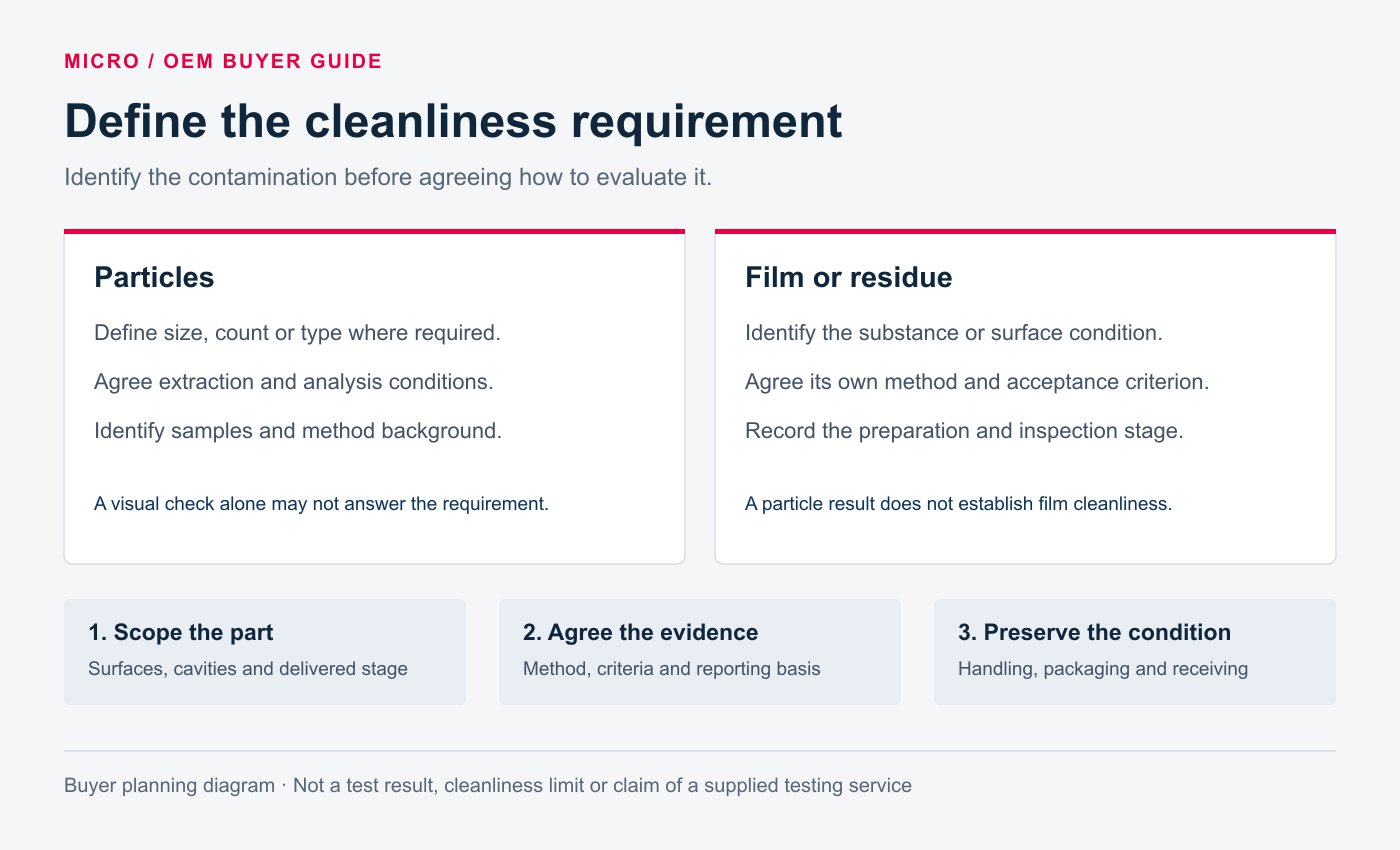
A turned component can look bright and pass its dimensional checks while leaving a cleanliness question unanswered. “Clean before packing” does not identify the contamination being controlled, the surfaces concerned or the evidence needed at receiving.
For custom CNC turned parts and precision shafts, turn that short note into an agreed inspection and handling requirement. This guide helps buyers prepare the discussion. Dedicated cleanliness testing, cleaning processes and reporting availability must be confirmed for the actual project; the website's general equipment list does not establish them.
Separate particles, films and attached edge defects
Identify whether the concern is loose particles, an unwanted surface film or a drawing-defined edge condition. Those questions can require different evidence. A satisfactory particle result does not establish the absence of an oil film; a smooth edge observation does not establish the particle condition elsewhere.
ISO 16232:2018's public abstract concerns particulate contamination on functionally relevant road-vehicle components and systems. It excludes film contamination and non-quantifiable visual or cloth-wipe assessment from its scope. It also does not set cleanliness limits for specific components. Do not turn its name into a universal limit for every turned part.
Keep an attached machining projection under the burr and edge-condition agreement. If particles can detach or migrate during later handling, discuss that contamination risk separately. Neither requirement should disappear because the other inspection passed.
Define the controlled surface and acceptance stage
Mark the relevant bore, passage, journal, groove or other region on the drawing or an agreed illustration. State whether the whole component is assessed or only a defined area. Ask how inaccessible regions will be included and which areas remain outside the inspection scope.
Identify the condition being accepted: after the specified final operation, after preservation and packing, or at a defined receiving stage. A result from an earlier stage should retain that stage identification. Do not silently treat it as evidence for a condition that was never tested.
For film-sensitive work, identify the substance or property of concern and the applicable method and criterion. A particle extraction report is not automatically the required film assessment. Resolve whether a permitted preservative is compatible with the later assembly, coating or bonding operation.
Agree the method before comparing results
A cleanliness test includes how contamination is collected and how it is evaluated. Ask the test provider to define the extraction approach, controlled region, preparation, parameters, analytical method and reporting basis. Confirm whether results concern one part, a group of parts or a stated surface area.
For particulate assessment, identify which results the application needs: for example, particle counts by agreed size classes, a maximum particle dimension, residue mass or material identification. These outputs answer different questions; select the required evidence rather than requesting every available test by default.
Method suitability matters. CleanControlling's discussion of extraction interferences explains that unsuitable chemicals or mechanical contact can release material that was not originally loose contamination, while inaccessible or bound particles may escape collection. Obtain a method review instead of assuming that a more aggressive extraction is necessarily more representative.
Name the specification and edition invoked by the order. VDA QMC lists VDA 19.1's third revised edition from February 2026. An older example or draft found online should not silently replace the agreed edition. This guide uses public source information and does not supply the standard's detailed procedure.
Request the background check and validity decision
A test can introduce contamination from its own apparatus or environment. CleanControlling defines a blank test as analysis under the component-test operating conditions without the component. Its purpose in the enquiry is to make test background visible alongside the component result.
Ask for the applicable blank criterion, observed background, method-validity decision and explanation of any restriction. A reported component value should not be read without those conditions. If validity is unresolved, retain that gap and request review before using the result for the agreed release decision. This article prescribes no universal blank percentage or subtraction rule.
Put the inspection agreement in the enquiry
The table is a buyer planning aid, not a MICRO test report or approved laboratory procedure. Complete it with the responsible engineering and test specialists.
| Decision | Information to agree | Evidence to retain |
|---|---|---|
| Contamination | Particles, film or both; relevant characteristics | Released requirement and acceptance criteria |
| Controlled region | Surfaces, passages, exclusions and access | Identified drawing or scope illustration |
| Acceptance stage | Operations completed, preservation and pack condition | Sampling stage and received condition |
| Sampling | Lot identity, selected parts and reporting basis | Sample identities and quantity |
| Test method | Extraction or film method, preparation and parameters | Agreed procedure and applicable edition |
| Background | Blank criterion and test-validity assessment | Background result and restrictions |
| Reporting | Required values, units, classes and relevant images | Results linked to method and sample |
| Handling | Sampling transport, packing, opening and repacking | Agreed preservation and handling instructions |
Keep requirements, measured results and the release decision as distinct entries. If a report omits the controlled region or sampling basis, ask for clarification rather than interpreting “pass” more broadly than the evidence supports.
Preserve the condition through sampling and delivery
Sampling and handling belong in the agreement. Ask how parts will be selected, removed, transported and unpacked without an undocumented change to their condition. Record any cleaning or preparation before testing. A receiving team should not clean a suspect sample first and then describe the result as its original arrival condition.
Packaging can affect the evidence as well as the product. The extraction-interference guidance identifies handling and packaging as possible routes for particles to be added or removed. Agree how the test provider treats packaging, and whether a pack-related observation is separate from the component assessment.
Review preservation, separation and transport under the shaft packaging guide and OEM order-delivery page. An intact pack or acceptable corrosion condition does not establish the specified cleanliness result. If subsequent opening, repacking or processing changes the agreed condition, record it and determine whether further evidence is needed.
Resolve a disagreement against the same inspection scope
When supplier and receiving reports differ, first compare part and revision, lot, sampled quantity, controlled surfaces, stage, preparation, method settings, analytical basis and blank assessment. Results from different conditions may not answer the same acceptance question.
Preserve both reports and the observed arrival condition. Agree the investigation, any further sampling and the authorized disposition. Recleaning a part or choosing the lower number does not explain the original disagreement. Review resulting changes through the drawing and change-control process.
For a MICRO enquiry, send the drawing, quantities, contamination concern, required finished condition and requested records using the RFQ checklist. Review the quality information and sample-document handoff, then start an enquiry and email the package to [email protected] with the enquiry reference. Confirm the feasible cleaning, testing and reporting scope before placing the order.