
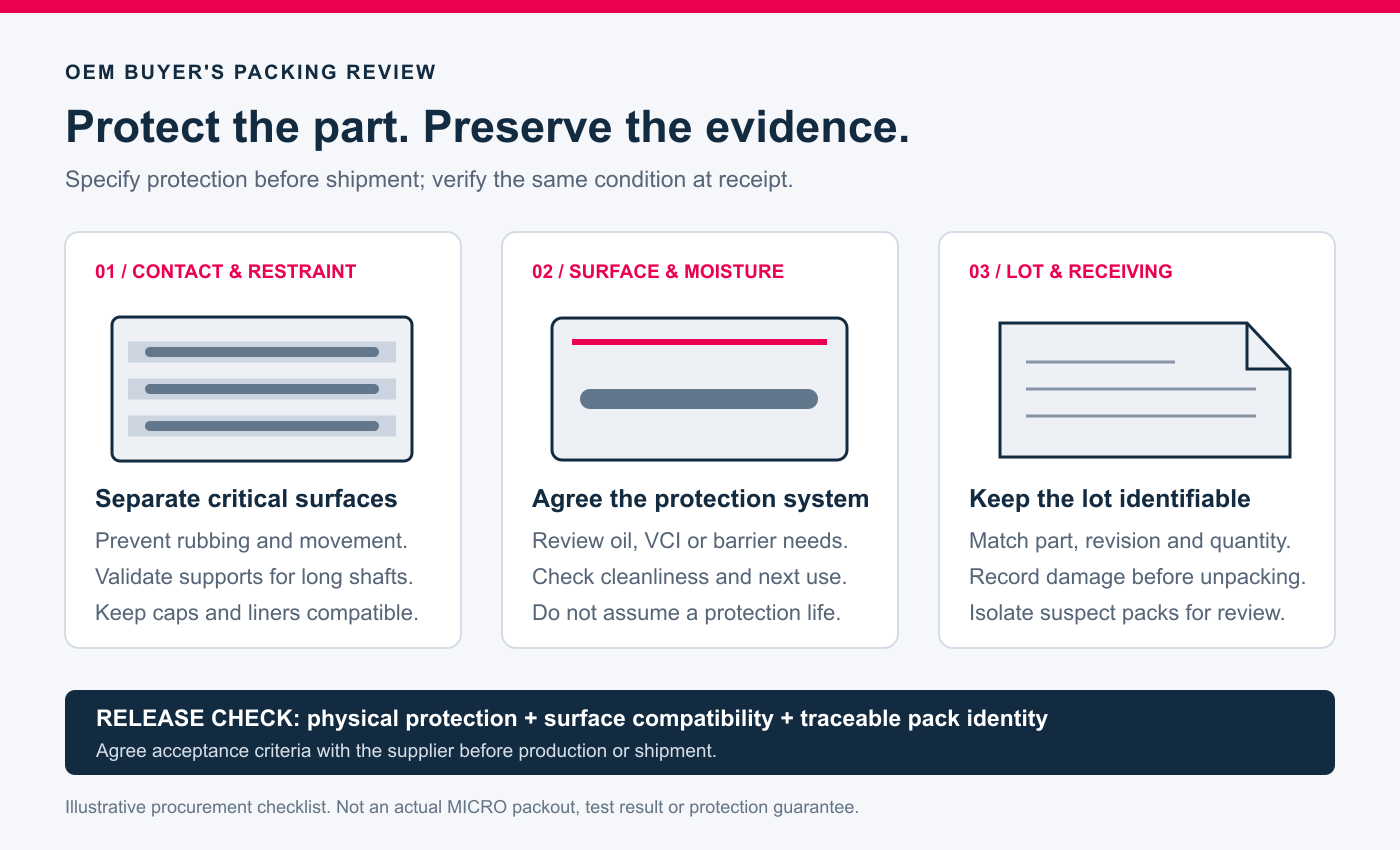
A precision shaft can leave final inspection within its drawing limits and still arrive with damaged working surfaces or an unresolved corrosion concern. Packaging requirements belong in the enquiry, alongside the drawing and inspection scope. The buyer needs to know what condition will arrive, how it will be protected, and how receiving staff should handle an exception.
Define the surface condition before choosing the package
State the material and delivered finish, including coatings, ground journals, bores and any surfaces that must remain free of added oil or other residues. Describe the next operation: direct assembly, washing, bonding, coating or further machining. An acceptable temporary protective film for one route may create an extra cleaning or qualification step for another.
Tell the supplier the transport mode, expected transit and warehouse time, likely handling changes and storage environment. Include time after the first opening if parts will be withdrawn in stages. These are inputs for a packaging review, rather than a promise that one bag type protects every shipment.
| Requirement | Information to provide | Agreement to record |
|---|---|---|
| Delivered surfaces | Metal, finish, functional areas and downstream operation | Allowed residues and any cleaning before use |
| Exposure | Journey, storage period, environment and opening frequency | Protection method and stated operating conditions |
| Mechanical protection | Features sensitive to contact, scratches or deformation | Separation, support and container arrangement |
| Identification | Part/revision, lot, quantity and receiving needs | Inner-pack and outer-box labels and record links |
Keep coating thickness and fit acceptance separate from temporary shipping protection. A protective package does not establish that a plated diameter meets the drawing.
Review corrosion protection as a complete system
ZERUST's drying guidance calls for parts to be clean, near ambient temperature and visibly dry before its VCI packaging is closed. Vapor corrosion inhibitor packaging does not remove trapped droplets or pooled liquid. Recesses and bores deserve attention during preparation. These principles do not mean every component requires an identical wash or drying process: agree a method compatible with its material and finish.
If VCI is proposed, identify the actual product and confirm its application with the packaging supplier. Cortec's VpCI-126 information describes a particular film's multi-metal protection and product-specific conditions. Its claims should not be transferred to an unspecified film or used as MICRO's shipment warranty. Request compatibility review for the complete material and surface combination.
ZERUST's closure guidance emphasizes limiting air exchange and water entry; vacuum removal is not inherently required. Agree the closure and handling instructions for the chosen system, including what happens after a sample is removed. An opened, damaged or incorrectly reclosed pack is a change in protection conditions.
Where desiccant, barrier material or a temporary liquid preservative is proposed, ask for a coordinated selection and packing instruction. Do not specify a generic packet count or a corrosion-free duration without the packaging supplier's design basis.
Separate shafts without loading their working features
Corrosion control and impact protection solve different problems. FedEx's automotive packing guidance recommends covering precision-machined areas and using cushioning with a suitable container to reduce scratches and dents. For small shafts, translate that principle into a drawing-specific pack layout.
Identify bearing or sealing journals, threads, thin ends and other features that must avoid damaging contact. Review individual pockets, sleeves, dividers or another suitable arrangement; do not assume loose bulk packing is acceptable. Confirm support locations and retention so parts cannot strike each other or repeatedly rub a functional surface during handling.
Check the assembled package, not just an empty tray. Review whether its inserts remain positioned, whether an end can puncture the enclosure, and whether the container can carry the packed mass. Padding an edge protects the package and handlers; it does not replace the drawing's burr and edge requirements.
Any required transit trial or test needs its own agreed configuration, acceptance criteria and evidence. A neat photograph of a packed box is useful for layout approval, but does not by itself demonstrate transport performance.
Connect the pack to the shipment records
A receiving team should be able to identify parts without mixing loose components from different packs. Agree inner-pack quantity, box numbering and whether lots may share an outer container. If they do, keep the inner identities distinguishable.
Link part number, drawing revision, lot and quantity to the delivery documentation and applicable release records. Where material heat identity is required, use the agreed material traceability chain. A shipping label cannot restore a lost connection between the physical parts and their supporting records.
Record the packaging instruction revision and any approved alternatives. For repeated orders, make a change to a contact material, preservative or packing layout visible for review rather than treating it as an inconsequential substitution.
Receiving example: hold the affected pack, preserve the evidence
The following identifiers, quantities and events are hypothetical teaching examples, not a MICRO shipment or test result.
An order contains 240 shafts in four identified inner packs of 60. Pack P-03 arrives with a torn enclosure and visible surface marks on some parts. Staff retain its label, photograph the unopened damage and then record the exposed condition. They identify P-03's 60 parts for investigation without mixing them with the other packs.
| Observation | Immediate record | Next decision |
|---|---|---|
| Torn enclosure or moisture | Pack ID, condition, photos and affected quantity | Review protection loss and inspection scope before use |
| Marks on a working surface | Feature location and identified parts | Assess against the drawing and agreed surface criteria |
| Label or quantity mismatch | Received labels, count and delivery reference | Resolve identity or shortage before releasing affected parts |
The intact packs are not automatically accepted or rejected because P-03 is affected. Apply the agreed receiving plan and determine whether the issue could extend further. Preserve evidence before cleaning or reworking suspect surfaces, and obtain an authorized disposition. Opening every pack unnecessarily may also alter its protection conditions.
Include packaging in the MICRO enquiry
Add the packaging requirement to your CNC turned parts RFQ. Send the expected delivered condition, exposure assumptions, sensitive features, packing quantities, label fields and any required approval or test evidence. Use the quality page to discuss inspection scope alongside the packaging review.
MICRO manufactures to customer drawings. This guide does not establish a default VCI system, vacuum pack, cleanliness class or corrosion-protection period for its orders. Confirm the actual proposal during quotation and before shipment. Start an enquiry and email your drawing and packaging requirements to [email protected] with the enquiry reference.