
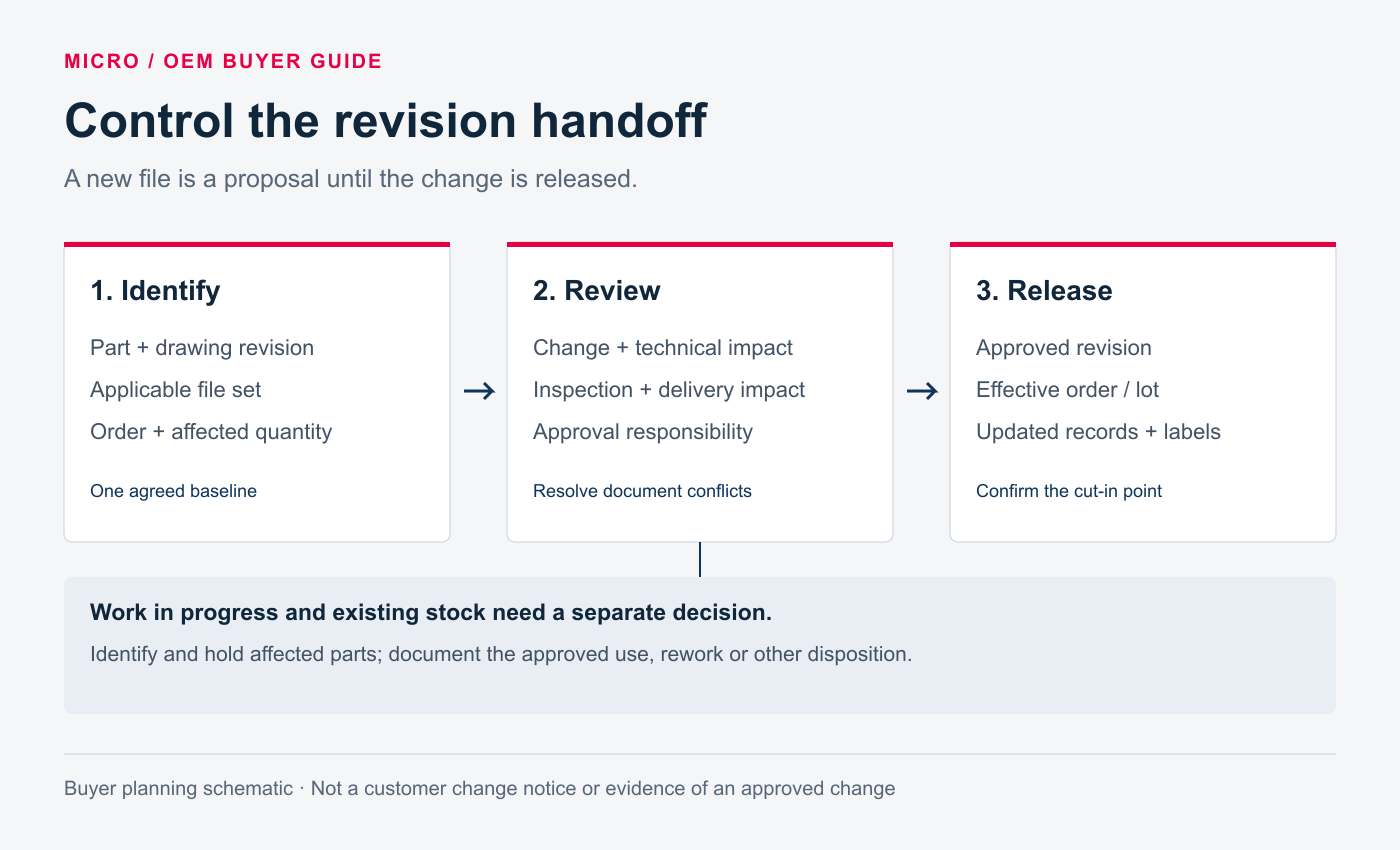
A repeat order can use a familiar part number and still describe a different component. The drawing may change while the supplier holds finished stock, partly machined pieces and material already allocated to the next batch. Sending the latest PDF does not decide what happens to those items.
This guide addresses that transition for custom CNC turned parts and precision shafts. It is a purchasing checklist for an agreed change process, not an instruction to override the design owner's release rules.
Identify the released package, not the newest attachment
List the part number, drawing revision, model version, referenced specifications and approved clarifications that define the order. Record each document separately: they need compatible requirements, not necessarily identical revision letters. Make review-only files distinguishable from files authorized for manufacture.
ASME Y14.35's public overview describes identification and recording of drawing revisions. The overview does not establish your contract's document precedence or authorize a particular change. Identify the applicable rules and editions in the project package.
If a model, PDF and purchase order disagree, obtain a controlled resolution from the responsible authority. A more recent file timestamp does not automatically decide which requirement governs. The RFQ checklist covers initial quotation alignment; a repeat order also needs a defined transition from the previous approved configuration.
ISO 10007's public abstract places configuration-management guidance across a product's life cycle. The practical buyer question is which approved definition applies to each batch throughout that life cycle.
Assess the change before authorizing its implementation
Provide a marked comparison or change description alongside the complete revised files. Identify affected characteristics and the reason for the proposed change. Ask the supplier to review manufacturing, tooling, gauges, inspection records, treatments, purchasing commitments, price and delivery consequences.
A changed edge note might affect a machining step, inspection access or a mating interface. A revised material specification could affect material already ordered. Do not assume that unchanged nominal dimensions mean the route and evidence remain unchanged.
NASA's requirements-management guidance connects change review with impact assessment and communication to affected organizations. Its agency-specific workflow is not imposed here on commercial machining orders; this checklist adapts the general principle of resolving impacts before implementation.
Distinguish the supplier's receipt acknowledgement, technical feasibility response, commercial agreement and authorization to proceed. “Received” is not evidence that every downstream work instruction has changed or that affected stock has been released.
Define the cut-in point and the old-stock decision
State exactly which purchase order, line, lot, serial range or other identifiable scope begins the new revision. A calendar date alone may be ambiguous when machining, treatment and shipment happen on different days. Agree how a split order will be identified.
Request an inventory breakdown for affected material, work in progress, finished stock, subcontracted work and dispatched items. For each category, record quantity, identity, current stage, proposed action and approval owner. Confirm a stop or hold instruction where needed rather than assuming that sharing a new drawing stops production.
Possible dispositions include completing an identified quantity to the old revision, authorized rework, replacement or rejection. None follows automatically from issuing the new revision. Establish who can approve each action, its limits and any required commercial adjustment. Prevent mixed revisions from entering an unidentified pack.
A temporary concession for a defined batch should remain distinct from a permanent design revision. NASA's configuration-management discussion likewise distinguishes approved baseline changes from limited departures. Follow your own contract's terminology, approval authority and traceability requirements.
Put the repeat-order decisions in one register
This table is an enquiry and release-planning aid. It is not a MICRO change notice, signed approval or customer record.
| Decision | Information to settle | Evidence to retain |
|---|---|---|
| Governing definition | Part identity, released files and referenced specifications | Controlled package list and resolved conflicts |
| Change scope | Old-to-new differences and affected interfaces | Change description and impact review |
| Cut-in | Identified orders, lots or units using each revision | Authorized effectivity instruction |
| Existing items | Material, work in progress, finished and dispatched quantities | Status list and authorized dispositions |
| Rework | Permitted operation, affected identities and reinspection | Approved instructions and resulting records |
| Verification | Checks affected by the change and evidence required | Agreed inspection or sample-review plan |
| Commercial scope | Added costs, timing and open commitments | Accepted quotation or order amendment |
| Closure | Implementation confirmation and remaining restrictions | Acknowledgements, release decision and delivery references |
Keep superseded files retrievable for history while withdrawing them from active instructions for the changed work. Retaining an old record and using it as today's production instruction are different actions.
Example: a revised groove with unfinished and finished parts
Consider a fictional turned shaft whose groove definition changes between Rev B and Rev C. This is a teaching scenario, not a MICRO model, customer case or approved machining proposal. No dimensions or quantities are prescribed.
Some pieces are awaiting groove machining; others are finished to Rev B. First identify both groups and hold the affected operation or shipment pending instructions. Review whether the unfinished pieces can follow the proposed Rev C route. Review the finished pieces separately; their existence does not establish that rework is technically possible or authorized.
The buyer's designated authority then records the decision for each group and the cut-in scope. If rework is approved, retain the original identity, rework instruction and required verification. If old-revision supply remains permitted, identify it explicitly on the order and delivery records. Do not relabel Rev B parts as Rev C simply because a new drawing arrived.
Close implementation through inspection and delivery
Review the inspection plan against affected requirements and any interactions introduced by the change. Determine which previous evidence remains applicable and which checks need new results. Do not copy an earlier report under a new revision without an authorized, documented basis for its applicability.
Where new samples or a formal submission are required, agree the scope before releasing the affected work. The sample approval guide explains the separate acceptance decision, while the sample and quality-document service page supports the enquiry handoff. Neither makes old approval automatically transferable.
Confirm updated instructions with the people performing machining, treatment, inspection and packing. Connect the delivered lot to its actual revision and agreed records. Preserve material links through any split or rework using the heat-traceability guide, and agree revision identification through OEM packaging and delivery.
For a MICRO repeat-order enquiry, send the previous and proposed released references, change description, intended cut-in and requested evidence. Review the quality information, then start an enquiry and email the drawing package to [email protected] with the enquiry reference. Ask for the technical and commercial response before authorizing the transition.