
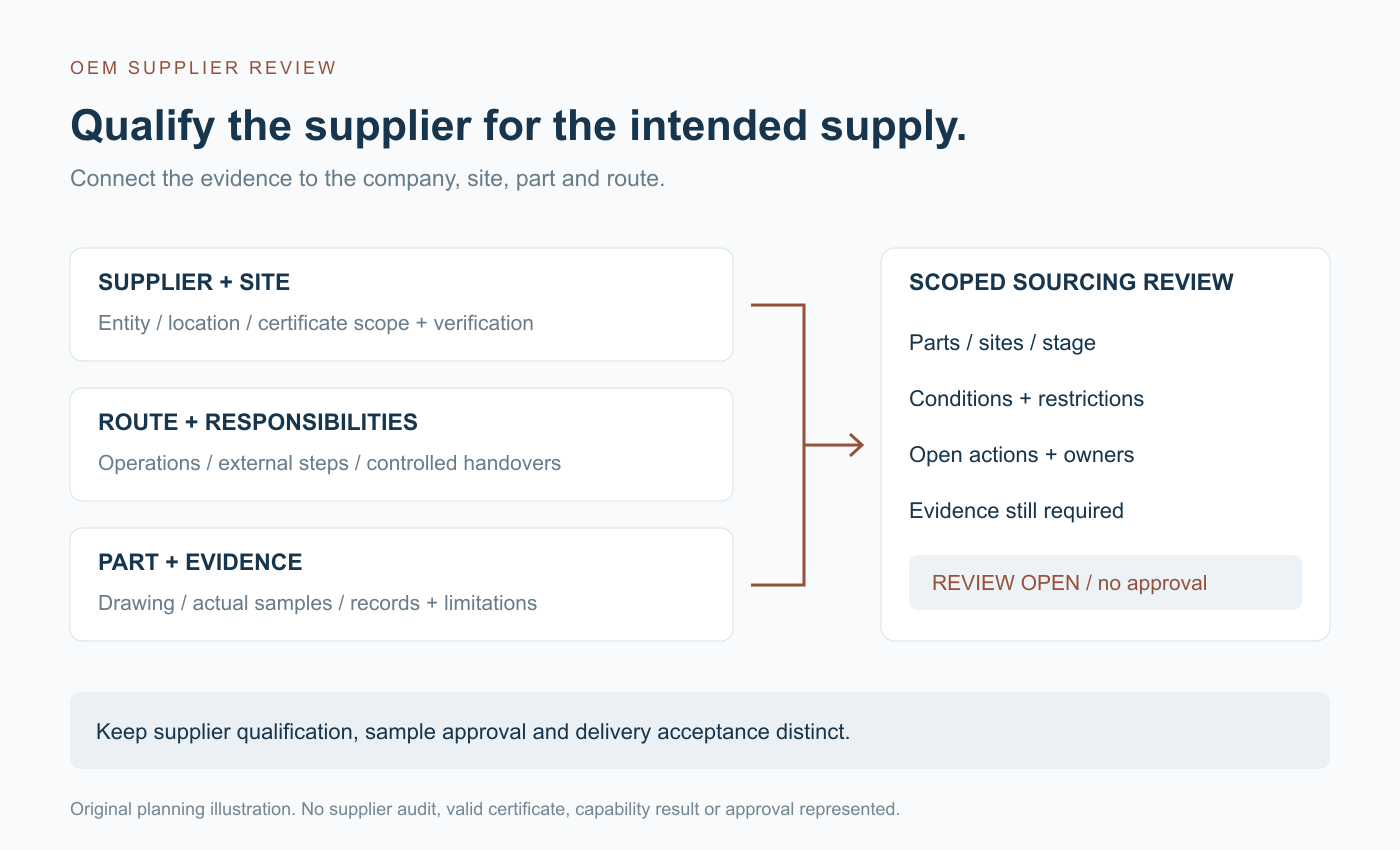
A supplier can show an impressive certificate, a clean workshop and a good sample while important purchasing questions remain unanswered. Before nominating a source for precision turned parts, connect the evidence to the actual company, site, drawing and production route you intend to buy from.
For custom CNC turned parts and precision shafts, qualification should end with a defined sourcing decision and visible conditions. This guide offers a buyer's evidence checklist. It is not a certification audit, a supplier ranking or a claim that every document or test described is included in a MICRO quotation.
Define the scope of the proposed supply
Identify the contracting supplier, proposed manufacturing site, part or part family, drawing revision and intended order scope. Explain the important features and service requirements without assuming that a broad statement such as “precision machining” covers every combination.
Separate sample manufacture, production supply and shipment authorization where your process treats them differently. Record who may approve each stage. A supplier's response can be sufficient to begin a technical discussion while still leaving nomination or production release unresolved.
Check what the certificate actually covers
ISO's conformity-attestation guidance distinguishes management-system certification from product certification. ISO's certification page explains that ISO does not issue certificates and describes verification through certification or accreditation bodies and verification services. Check the actual evidence and its scope before relying on it.
Review the certificate's legal entity, site address, scope, standard or edition, identifying number and status. Check additional sites when relevant, and ask the issuer about discrepancies or transition questions. A familiar brand name on a sales presentation is not enough to link a certificate to the company and location in the proposed order.
Treat certificate review as one part of qualification. It does not replace evidence for the specified material, feature, process or finished-part acceptance. If verification is inconclusive, preserve the question and seek clarification rather than silently marking it approved or declaring the certificate invalid from an incomplete search.
Connect the quotation to an actual process route
Ask for the intended sequence of relevant operations and which organization or site performs them. Include externally arranged treatment, finishing or inspection where applicable. Agree who transfers requirements, preserves lot identity, reviews returned work and supplies the required records.
Outsourcing is a route question to evaluate, not an automatic reason to reject a supplier. The purchasing issue is whether the responsibilities and evidence support the agreed requirement. A price that includes treatment does not by itself identify the treatment provider or its control arrangements.
Use the RFQ checklist to clarify the commercial and technical scope, then review how proposed site or route changes will be communicated and authorized. Keep unresolved external-process assumptions visible before order confirmation.
Request evidence representative of the difficult features
A photograph can show a type of part without demonstrating its measured size, form or suitability for your assembly. Ask which features make the proposed part demanding and what relevant evidence can be shared. Comparable work should be described honestly, with any differences and limitations identified.
For a sample or report, identify the drawing, actual samples, measured characteristics, manufacturing condition and inspection scope. Follow the inspection-report guide for the record details. A report for a simpler sample should not silently become proof for a more demanding feature or a changed production route.
NIST's acceptance-sampling introduction describes a decision about an identified lot under a sampling plan. A selected sample or one accepted lot does not establish the supplier's long-term performance across every future order.
AIAG's public PPAP overview connects part approval with production-process evidence against design requirements. Where a customer requests PPAP or another defined package, agree its applicable scope and production conditions. Do not assume that every inquiry requires the same package or that a trial sample represents the planned production route.
Use a qualification record that shows remaining questions
This table is a starting structure. Agree the actual evidence, review responsibility and conditions for the project rather than treating every row as a universally mandatory document package.
| Review area | Evidence or clarification to request | Decision boundary |
|---|---|---|
| Supplier and site | Contracting entity, manufacturing location and relevant contacts | Confirm what organization and site the review concerns |
| Certification | Applicable certificate, scope and verification response | Keep verification gaps open; do not infer part conformity |
| Process route | Relevant operations, locations and external-process responsibilities | Identify what the proposed route includes and excludes |
| Critical features | Representative sample or method evidence tied to the drawing | Record differences from the intended part or production condition |
| Material identity | Agreed material records and lot linkage | Confirm the required chain, not just a certificate filename |
| Inspection | Characteristics, methods, samples and reporting basis | Separate dimensions, attribute checks and assembly evidence |
| Changes and exceptions | Notification, approval and disposition responsibilities | Define which decisions remain conditional |
| Delivery handover | Required records, identification and receiving checks | Agree what must accompany the identified shipment |
Keep identity and change control continuous
Qualification documents become less useful if their identities disappear between material receipt, machining, treatment and packing. Agree how the material and heat-traceability chain will connect the delivered parts to supporting records. Request only the documented scope needed for the order; “full traceability” without defined links remains ambiguous.
Record the baseline that the sourcing decision relies on. Identify relevant sites, route assumptions, approved exceptions and any evidence still due. Use the drawing and change-control guide when a later change affects the agreed requirements or their implementation.
Close actions before expanding the approval scope
Consider a fictional shaft quotation. The supplier provides a certificate for the named site and a dimensional report for a sample, but the proposed treatment route and its return-inspection responsibility are unclear. Those two records do not resolve the route question.
Assign an owner to clarify the treatment arrangement and required handover evidence. Record what can proceed while the issue is open and which release remains blocked, according to the buyer's approval process. A satisfactory answer should be linked to the sourcing record; it should not be assumed from a certificate or an attractive lead time.
When recording a decision, name the reviewer, date, covered parts and sites, order or stage scope, conditions and open actions. Supplier qualification, sample approval and acceptance of an individual delivery can be separate decisions. Keep their authorizations distinguishable.
Start a focused supplier review
Send the controlled drawing, quantities, priority characteristics and requested evidence scope through the quotation page or email [email protected]. Review the published manufacturing information and quality information, then confirm the feasible route, documentation and remaining questions for the actual project before order confirmation.