
A material certificate is useful only when the supplied parts can be connected to the material it describes. For custom CNC turned parts, agree the document type, material specification and identity chain before ordering. Keep raw-material evidence separate from the inspection that releases finished geometry.
Specify the document behind the label
“Material cert” and “CoC” leave purchasing questions open. Define what the supplier must declare, which requirements it references and which supporting results must accompany delivery. A general supplier certificate of conformity should not be assumed to mean EN 10204 type 3.1.
BSI identifies BS EN 10204:2004 as the current release covering types of inspection documents. Its document classification is separate from the material grade and product specification.
| Requested record | What to agree | What it does not establish alone |
|---|---|---|
| Supplier CoC | Issuer, order, part/revision, declared requirements and delivery identity | The specific test evidence required from the raw-material producer |
| EN 10204 type 3.1 for raw material | Applicable specification, supplied material identity and required inspection results | Final machined dimensions or every later treatment result |
| Finished-part inspection report | Drawing revision, characteristics, coverage and delivered condition | The original material heat identity without a linked record chain |
SSAB's inspection-document guidance explains that type 3.1 includes specific inspection results and is validated by the manufacturer's authorized inspection representative, independent of the manufacturing department. That independence does not inherently require an inspector from outside the manufacturer. Specific inspection can concern an inspection batch; it does not mean every finished component was individually tested.
Specify the required chemical and mechanical results, where applicable, against the actual product standard and order. Confirm availability before material allocation; this guide does not promise type 3.1 supply for every grade or order.
Follow one heat through split lots and rework
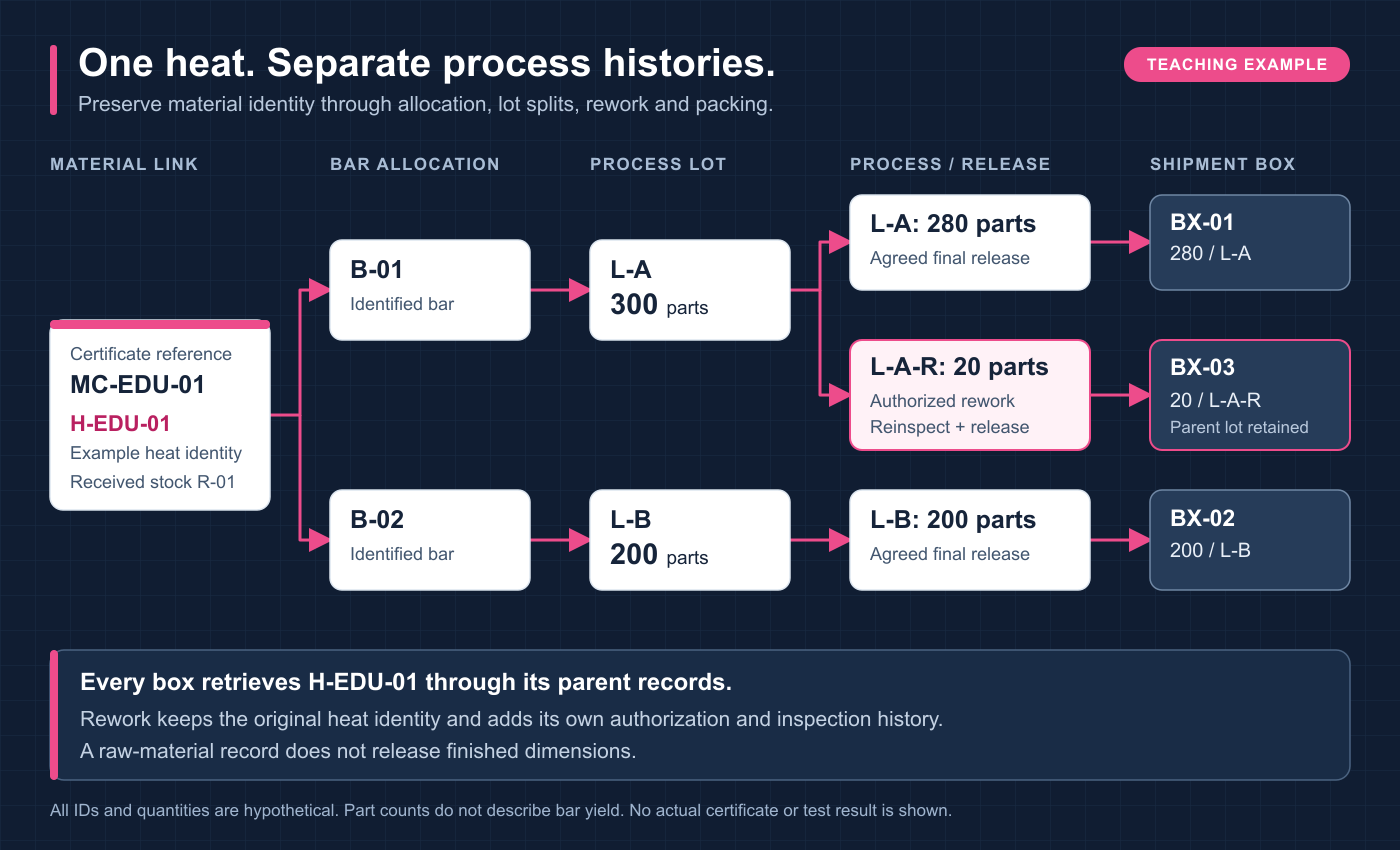
Every identifier and quantity below is hypothetical. This is a teaching record chain, not a MICRO order, certificate, inspection result or material-yield calculation.
An incoming record connects certificate MC-EDU-01 and heat H-EDU-01 to received stock R-01. Two identified bars, B-01 and B-02, are allocated separately. The cut-stock record maps B-01 to process lot L-A, containing 300 parts, and B-02 to L-B, containing 200. Cutting must preserve the link through identified containers or another agreed method when the original bar marking disappears.
L-A splits again: 280 parts proceed to the agreed final release, while 20 become rework sublot L-A-R. Record the parent lot, quantity, reason, authorization and affected operations. Rework does not create a new raw-material heat. It requires its own process history and the agreed reinspection of affected requirements.
The packing record maps box BX-01 to 280 released L-A parts, BX-02 to 200 released L-B parts and BX-03 to 20 L-A-R parts after authorized rework and release. All three retain H-EDU-01 through their parent records. A shared heat does not justify merging their different process histories.
If a second heat is introduced, create a separate allocation and identify its boxes or subpacks. A purchase-order number shared by both heats is insufficient to recover which material reached which parts.
Put the retrieval fields in the RFQ
Request a record structure that can answer a question from either end: “Which boxes contain this heat?” and “Which material and process records support this box?”
| Record group | Fields to identify | Buyer check |
|---|---|---|
| Order and design | PO/line, part number, drawing revision, material specification and condition | Records reference the released requirements |
| Material receipt | Producer, certificate ID/version, heat, stock identity and quantity | Certificate and received stock are linked |
| Production history | Process lot, parent/child splits, quantities and treatment references where required | Different routes remain distinguishable |
| Exceptions and release | Rework/deviation authorization, affected quantity, inspection and release references | Disposition applies to the identified parts |
| Shipment | Delivery note, box/subpack ID, part/revision, lot and quantity | Packing identity retrieves the supporting chain |
Agree retention time, document format, delivery timing and who can retrieve the records. Add this scope to the RFQ checklist; “full traceability” without defined links and retrieval expectations remains ambiguous.
Hold missing or mismatched evidence for resolution
If the certificate shows a different heat, grade or delivery condition, identify and segregate the affected material or parts while the discrepancy is investigated. Preserve the received document and label information. Ask the supplier to establish the correct linkage and obtain an authorized disposition before the affected release.
Dillinger's certificate-verification guidance distinguishes checking a document's content with its issuer from proving that the document belongs to the physical material. Both questions matter. Do not silently alter a heat number or attach a similar certificate.
Where identity has been lost, an agreed additional test may answer a defined material question. It does not recreate the missing process history or automatically turn an unidentified lot into a documented type 3.1 delivery. Keep the gap and disposition visible.
Keep other acceptance questions separate
Material heat traceability follows material identity through handling and production. NIST's metrological traceability guidance concerns measurement results connected to references through a documented calibration chain, including measurement uncertainty. A heat number establishes neither a dimensional result nor its metrological traceability.
Likewise, raw-material certification alone does not establish complete RoHS or REACH compliance for the delivered article. Request applicable substance information for its material and treatments separately; consult the European Commission's RoHS overview and ECHA's articles guidance for the relevant scope.
Confirm the evidence for the actual MICRO enquiry
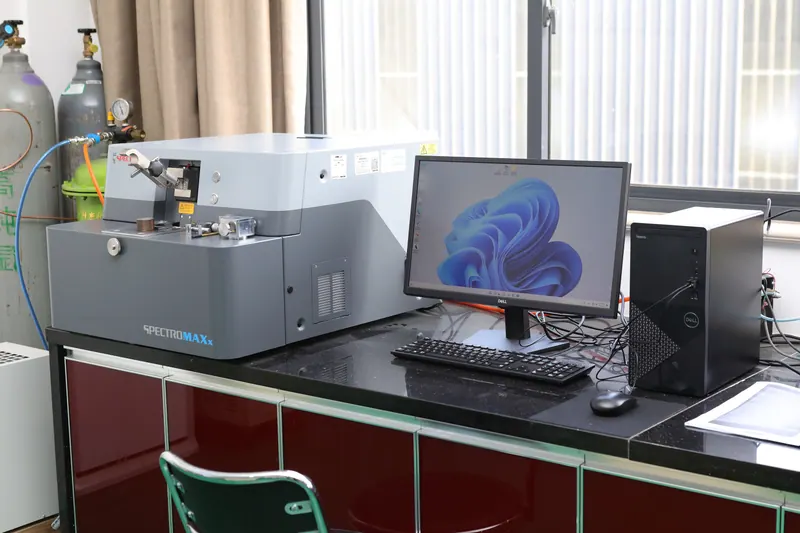
MICRO manufactures to customer drawings. Its manufacturing route and quality information describe production resources, ERP/MES records and a listed spectrometer. These resources do not establish every-lot chemical testing or certificate availability for a particular enquiry. Confirm the material documents, identity controls and reporting scope during review.
Use the sample approval guide to agree finished-part evidence. Then start an enquiry and email the drawing to [email protected] with the inquiry reference, including your certificate and traceability requirements.