
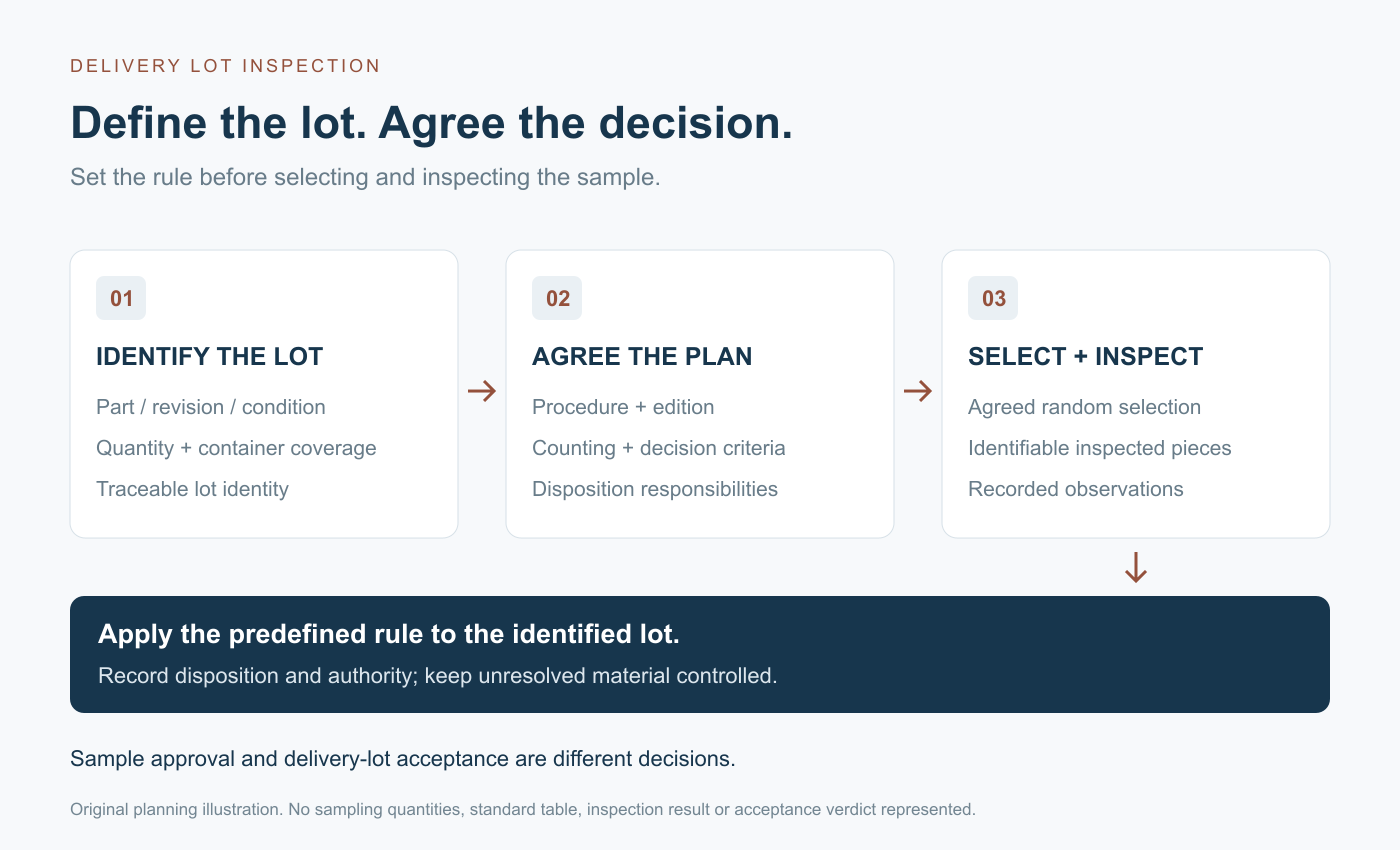
An approved first article does not answer whether an incoming delivery should be accepted. A batch may contain several production periods, labels or processing stages, while its inspection report represents only selected pieces. Before specifying “AQL inspection,” connect the decision to a clearly identified lot and an agreed sampling procedure.
This guide helps OEM buyers prepare that agreement for custom CNC turned parts, precision pins and similar drawing-controlled components. It does not provide a ready-to-use sampling table or authorize a shipment.
Separate three decisions before choosing a sample
Supplier qualification evaluates the proposed supply arrangement. Sample approval evaluates specified evidence for a trial or release stage. Lot acceptance applies an agreed procedure to an identified delivery lot. Evidence from one decision may inform another, but their scope is not interchangeable.
NIST describes acceptance sampling as using a random sample to decide the disposition of a lot. Its purpose is the acceptance decision, rather than a precise estimate of the lot's quality. Acceptance does not demonstrate that every piece conforms; rejection does not establish that every piece is defective.
State what the lot decision permits: receiving into a holding area, release to stock or another defined action. Keep any unresolved drawing or safety requirement visible to the authorized buyer.
Define the lot and the item being counted
Identify the population from which the sample will actually be drawn. Specify the part number, drawing revision, delivered condition, lot identifier and quantity. Record the production or treatment grouping required by the order, together with traceability to the containers presented for inspection.
Do not assume that one delivery note automatically defines one acceptable inspection lot. Conversely, do not split a lot into convenient smaller groups simply to obtain a more favorable result. Agree how mixed revisions, unidentified containers, reworked pieces and partial deliveries will be handled before applying the plan.
Define the decision unit as well. A nonconforming part and a count of individual nonconformities are different inputs. One component might have more than one nonconformity. The selected procedure must match what the inspector records, rather than changing the counting basis after inspection.
Put the sampling agreement into the order
Use this checklist to expose missing instructions before the shipment arrives. Fill it with the applicable customer requirements and the complete selected procedure; the table itself is not a sampling plan.
| Agreement item | What the buyer should record | Why it matters |
|---|---|---|
| Lot identity | Part, revision, condition, identifier, quantity and container coverage | Defines the population represented |
| Decision unit | Nonconforming units or specified nonconformities | Prevents incompatible counting |
| Characteristics | Requirements, categories and acceptance criteria | Connects the decision to the drawing |
| Procedure | Agreed standard or customer plan, edition and applicable rules | Makes the method reproducible |
| Selection | Random selection method and access across the lot | Avoids inspecting only convenient pieces |
| Plan parameters | Required sample size and acceptance/rejection criteria | Establishes the decision before results are known |
| Measurement | Equipment, method, finished stage and recording format | Gives each observation a defined meaning |
| Disposition | Decision authority, hold, segregation and reinspection instructions | Prevents unapproved release or resampling |
For a measurement such as pin diameter, distinguish the observed numerical value from its conformity classification. Use the gauge-selection guide to agree the measurement task and the inspection-report guide to connect the recorded observations to the sampled pieces.
Understand AQL and the risks behind the decision
An AQL designation alone leaves the agreement incomplete. ASQ distinguishes attribute and variable sampling systems: they use different forms of data and have different application conditions. Its Z1.4 overview describes a system for a continuing stream of lots, with switching rules. Do not take an isolated table row and silently discard the procedure around it.
Likewise, the ISO 2859-1 public overview describes AQL-indexed attribute schemes for lot-by-lot inspection. Name the edition required by the contract. The existence of a newer edition does not, by itself, rewrite an existing order's inspection agreement.
As explained in NIST's sampling-plan guidance, a plan has acceptance probabilities at different quality levels. Producer's risk concerns rejecting at a specified acceptable quality level; consumer's risk concerns accepting at a specified unacceptable quality level. Review those reference levels and risks together. An AQL is not a warranty that an accepted shipment contains no more than that percentage of nonconforming parts.
Check whether the sample can represent the delivery
Arrange access to the identified population before selection. A random selection procedure should not quietly become “take the first pieces from the nearest tray.” Record how selected pieces remain identifiable through inspection and reporting. Do not replace a failed selected piece with a convenient conforming one.
Here is a fictional receiving example, not a MICRO inspection record. A buyer orders one drawing revision, but the delivery has four labeled containers and one unmarked container. The report identifies only the four labeled containers. A result for their sample does not establish the identity or coverage of the unmarked container. Hold the unresolved material, establish its traceability and agree the lot boundary before deciding which sampling procedure applies. No sample size or inspection result is supplied in this example.
Decide what happens after rejection or uncertainty
Record the original sample observations, applicable criteria and decision. Segregate held material and identify who can authorize its disposition. Do not erase the original result by repeatedly taking fresh samples until one passes.
If screening, rework or resubmission is proposed, agree the affected scope, identification, evidence and applicable reinspection rules. Preserve the link to the original lot. These actions may require different records; they do not automatically convert the original rejected lot into an accepted one.
For characteristics needing stronger controls, discuss the appropriate inspection or prevention approach with the responsible technical owner. A zero-acceptance sample does not prove zero defects in the remaining lot. Nor does 100% screening remove errors caused by an unsuitable method, handling or an incorrectly defined characteristic.
Ask for the plan before comparing inspection costs
When contacting MICRO, send the released drawing, quantities, delivered condition and requested acceptance records. Ask for confirmation of the proposed inspection and reporting scope; do not assume that a particular AQL, sample size or universal 100% inspection is included. The quality page provides context for that discussion.
The RFQ checklist helps carry the agreed requirements into comparable quotations. Start with the inquiry form, then email drawings to [email protected] with the inquiry reference. The form does not accept drawing uploads. Keep open inspection decisions assigned to a named owner before authorizing delivery release.