
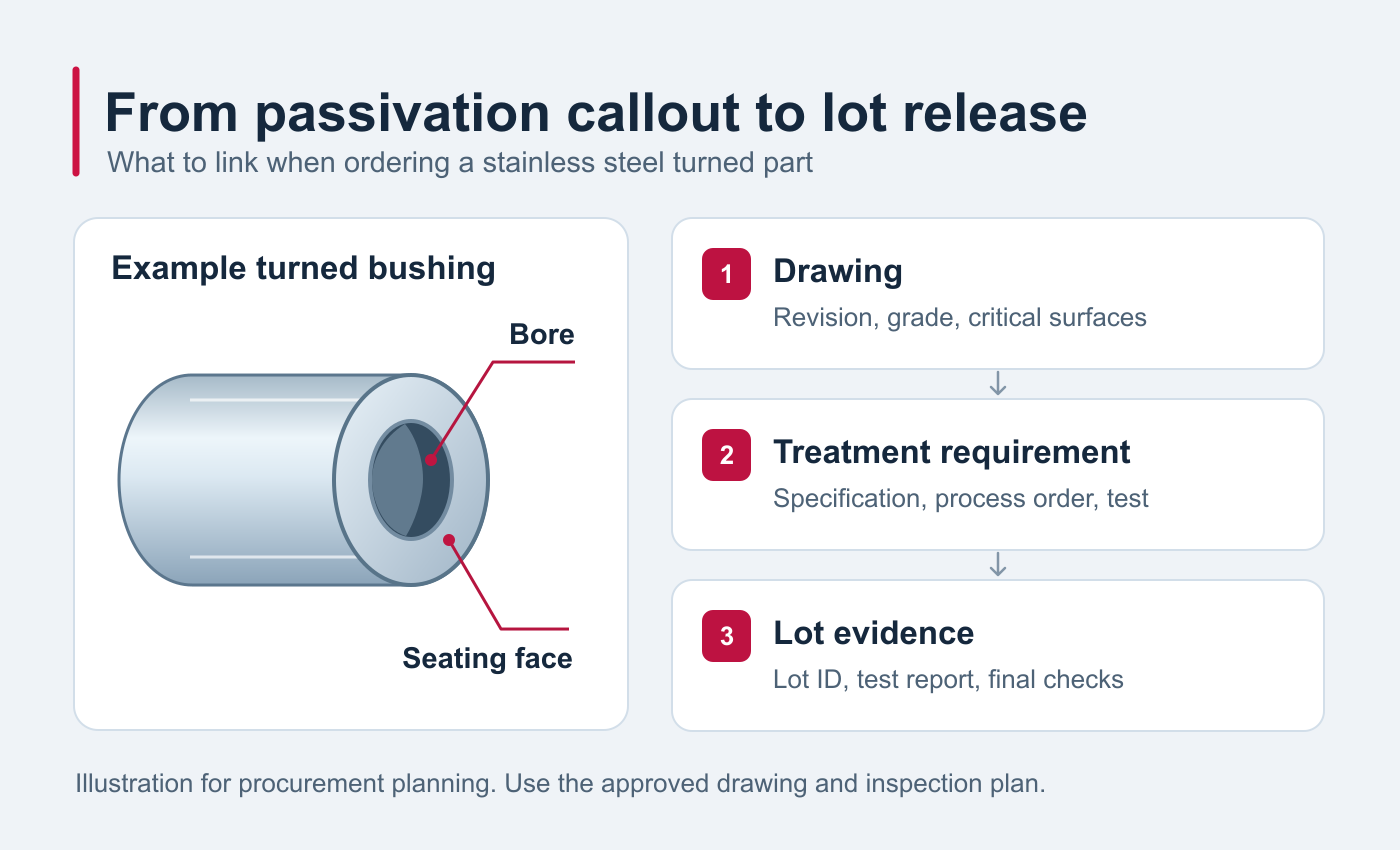
Identify what is on the surface
Stainless steel forms a thin passive oxide film on a clean surface in an oxygen-containing environment. Specified chemical passivation can remove contaminant iron left by fabrication or handling and help the passive film develop. Here, free iron means iron contamination on the surface. The iron in the stainless alloy remains part of the material. Australian Stainless Steel Development Association on pickling and passivation
Cutting fluid, loose chips and other machining residues need cleaning appropriate to the part before treatment. Heat tint or oxide scale from a thermal operation needs a separate evaluation. Where the oxide and affected metal underneath must be removed, ask the processor to quote the specified descaling or pickling operation. Give special attention to a sealing face or close-fitting diameter, since pickling can remove metal and change appearance. Specify the final surface texture and any visual criteria independently. IMOA, Nickel Institute and ICDA fabrication guide, post-fabrication cleanup
Agree the treatment sequence for the finished part
Mark the working surfaces on the drawing. On a small turned component, that might include a ground journal, an internal thread and the bottom of a blind bore. Ask the supplier to identify surfaces that are hard to reach or drain and to explain how the quoted route covers them. If the design excludes a surface or requires selective treatment, mark the boundary and have the processor confirm that it can be achieved and checked. ASTM A380/A380M provides guidance on cleaning, descaling, pickling and passivation. Its scope discusses both contamination control and protection of cleaned surfaces. ASTM A380/A380M public scope
Review the stage of grinding, threading and marking before locking the route. A later cut can expose a new surface, and handling after treatment can reintroduce contaminants. If the supplier proposes reworking a treated feature or moving a finishing step, ask which surfaces are affected and who approves any repeat treatment and verification. Mark the groove, bore or thread dimensions that must be checked in the delivered condition. If the component also has particle or film limits, specify those separately and give each check its own acceptance stage. The technical cleanliness guide explains how to define those limits and tests.
Write a passivation requirement that can be verified
ASTM A967/A967M covers chemical passivation of stainless steel parts and includes alternative qualitative verification practices. Use the edition invoked on the released order. Ask the design or quality owner to approve the applicable treatment options and verification practice for the material and application. Agree how parts or permitted representative specimens are selected, which observations are recorded, and what constitutes a pass. A test that confirms treatment effectiveness under specified conditions provides process acceptance evidence. Service life needs its own evaluation against the operating environment. ASTM A967/A967M public scope
| RFQ item | Give the supplier | Agree before releasing the order |
|---|---|---|
| Part and material | Released drawing, exact stainless grade and material condition | Governing documents and approval for any proposed alternative |
| Treatment | Standard and edition, and any required treatment designation | The route being quoted and any restrictions on alternatives |
| Coverage | Surfaces in scope, exclusions, and relevant blind or recessed features | How the route reaches critical surfaces and preserves the specified finish |
| Sequence | Machining, grinding and marking steps that affect the surface | Finished-condition checks and what happens after later rework |
| Verification | Required test or approval path for selecting a practice | Lot definition, sample plan, test criterion and recorded results |
| Release records | Part, shipment and any required material trace identifiers | How the processor's treatment lot and test record map to received parts |
Match the certificate and test record to the shipment
Consider a fictional order for a turned stainless bushing with a bore and seating face. The PO requires a named verification practice and a report linked to the shipment. The processor's certificate says the bushing was passivated and names a treatment batch. The shipment labels identify two delivery lots. The available test sheet says “pass” but leaves the practice and tested batch blank.
Ask for the record that links each delivery lot to the treatment batch and the corresponding test outcome. Confirm that the test sheet names the agreed practice and identifies the tested parts or specimens. Keep the affected lots on hold while the evidence gap is resolved. If the link cannot be reconstructed, ask the designated approver for a disposition under the agreed quality procedure. A separate material certificate and heat-traceability record can still be needed to show which stock went into the parts.
Send the treatment requirements with the quote request
For custom CNC turned parts, include the drawing, finish requirements, treatment coverage and evidence expectations in the RFQ package. Use the quality page to discuss the delivered-condition checks and request a quote for the finished part. Ask for confirmation of the quoted route, processor handoff and report contents before comparing prices.