
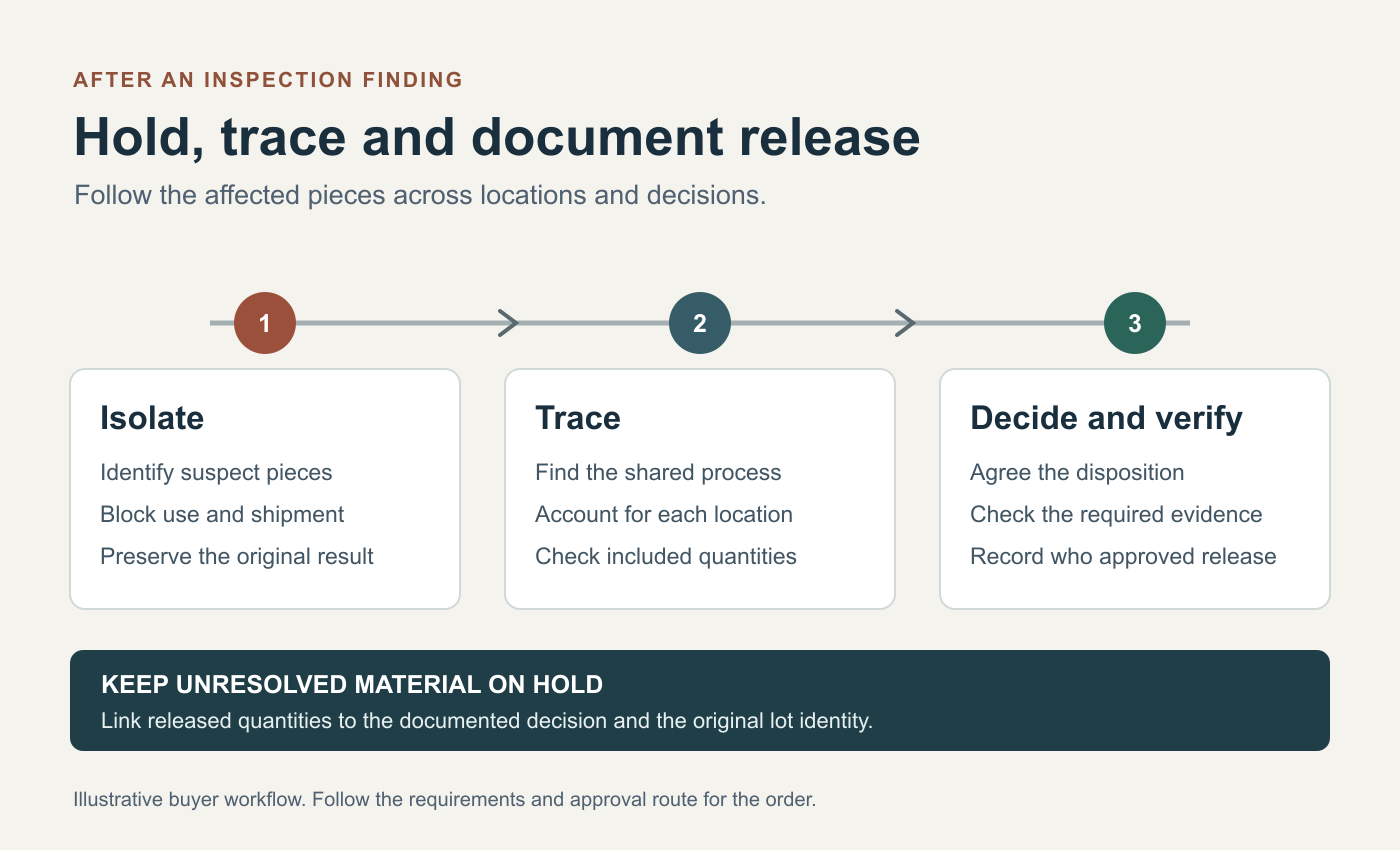
This guide applies after a specific discrepancy has surfaced on a drawing-led order for custom CNC turned parts or precision shafts. After an inspection discrepancy is reported, keep each lot’s status explicit. An acceptance sampling plan describes how to judge a submitted lot. The steps below cover the decisions that follow a specific finding.
Hold the material and preserve the finding
Mark the suspect pieces and keep them separate from usable stock. Block inventory from being issued, packed or shipped, including quantities held by a subcontractor if relevant. If affected pieces may have left the supplier, identify the shipment and tell the receiving team which material to hold. Verify who has received the instruction and whether any pieces have already entered assembly. Document the time, quantity and location of each hold.
Start the nonconformance record with the part number, order line, drawing revision and exact requirement. Record the result, feature location, sample identity and inspection method. Retain the original reading or image along with the setup, instrument and inspection stage. If a fixture or reference setting could explain the result, agree how to check it and preserve the original evidence. Link any repeat readings to the same piece, with the changed conditions and the reason for the repeat. The inspection-report review guide lists the details buyers can use to compare those records.
NASA's systems engineering handbook offers a verification example for this distinction. It calls for reviewing discrepancies to establish whether they arise from the product or the verification conditions and recommends investigating while the setup is still intact where possible. NASA Systems Engineering Handbook, section 5.3.1.2.3
Establish the affected quantity before narrowing the hold
Start with the credible exposure, which may cross carton or order boundaries. Check whether the suspect pieces share a machining setup, tool setting, material identity, outside operation or inspection configuration. Break the population down into work in progress, finished stock, goods in transit and received material. Record quantities under each identity and keep the boundary open if records cannot separate potentially affected pieces.
Two separate pallets can contain material from the same operation. Before clearing a group, ask which trace record, process boundary or agreed check supports the decision. Preserve the link between any sorted group and the original lot. Relabeling every screened piece with a new identifier is useful only if the new identity remains traceable to the disposition and parent lot.
Choose and document the disposition
Use your order and quality agreement to assign decision authority. The buyer, quality team and design owner can have different roles. Obtain technical and contractual authorization before carrying out a proposed exception where the agreement requires it. Record the person or function that approved any decision, the covered pieces and the conditions.
| Decision | When it fits | Evidence to retain |
|---|---|---|
| Verify the finding | The requirement, setup or measurement basis is unclear | Original result, agreed check, repeat results and conclusion |
| Screen an identified quantity | An agreed method can detect the specific condition on each checked piece | Method, covered characteristics, checked quantity, separated outcomes and trace IDs |
| Rework to the existing drawing | An authorized operation can restore the specified condition | Instructions, operation record and required reinspection results |
| Repair | An agreed operation makes the part suitable for the intended use while an original requirement may remain unmet | Approved instructions, residual deviation, authorized concession where required and verification results |
| Use as is | The authorized parties accept a stated condition without further work | Technical rationale, written acceptance, exact scope and restrictions |
| Return, replace or scrap | The order calls for withdrawal or correction is unsuitable | Authorized action, identities, quantities and disposition confirmation |
JPL's subcontract clause QC120 is one sector-specific example. It distinguishes rework that brings the item into conformity from repair and use-as-is, and reserves different decisions for the subcontractor and JPL. The parties to a commercial machining order should establish their own approval route. JPL quality clause QC120
Two trays from the same machining setup
In this fictional example, a receiving team finds a groove width outside the specified limits on a turned shaft. It holds tray A, containing 40 pieces, and sends the failed piece’s identity and measurement record to the supplier. Trace records show that tray B contains 20 pieces from the same setup and is at a second receiving location. The second location confirms the hold. Quality checks whether pieces have entered assembly and agrees what evidence can clear either group.
The buyer and supplier agree which feature and measurement method the screen will cover. The supplier records the screened, conforming and nonconforming quantities by tray. Some pieces can be reworked to the drawing under authorized instructions. Before releasing those pieces, quality checks the groove and any related features the operation could affect, such as adjacent edges. Pieces that still deviate require their own disposition. The disposition record balances the original 60 pieces: 40 passed the agreed screen and were authorized for release, eight were authorized for release after rework and reinspection, four are set aside for return, and eight still await disposition. The findings, quantities and tray identities are illustrative.
Tie release to the decision and keep corrective action separate
Record the part, revision, lot or tray, quantity, disposition, supporting verification and release authority on the release record. For an approved concession, identify the precise requirement affected, its allowed scope and any marking or use restrictions. Future deliveries follow the released specification unless their authorization covers them. See the drawing revision control guide for permanent changes.
The U.S. Federal Acquisition Regulation illustrates why an exception decision should name its scope, technical basis and approval authority. Its acceptance process is specific to U.S. federal procurement. FAR 46.407
Assign owners to investigate both how the defect occurred and why it escaped detection. Agree how they will verify the corrective action on later production. ASQ’s 8D method describes interim containment, root-cause investigation and validation of permanent corrective action as separate stages. ASQ Eight Disciplines problem solving
For an existing order, send the original order contact the affected quantities and findings. Review MICRO’s inspection and quality information before defining evidence for a new part, and include any special notification or approval requirements when you request a quotation.