
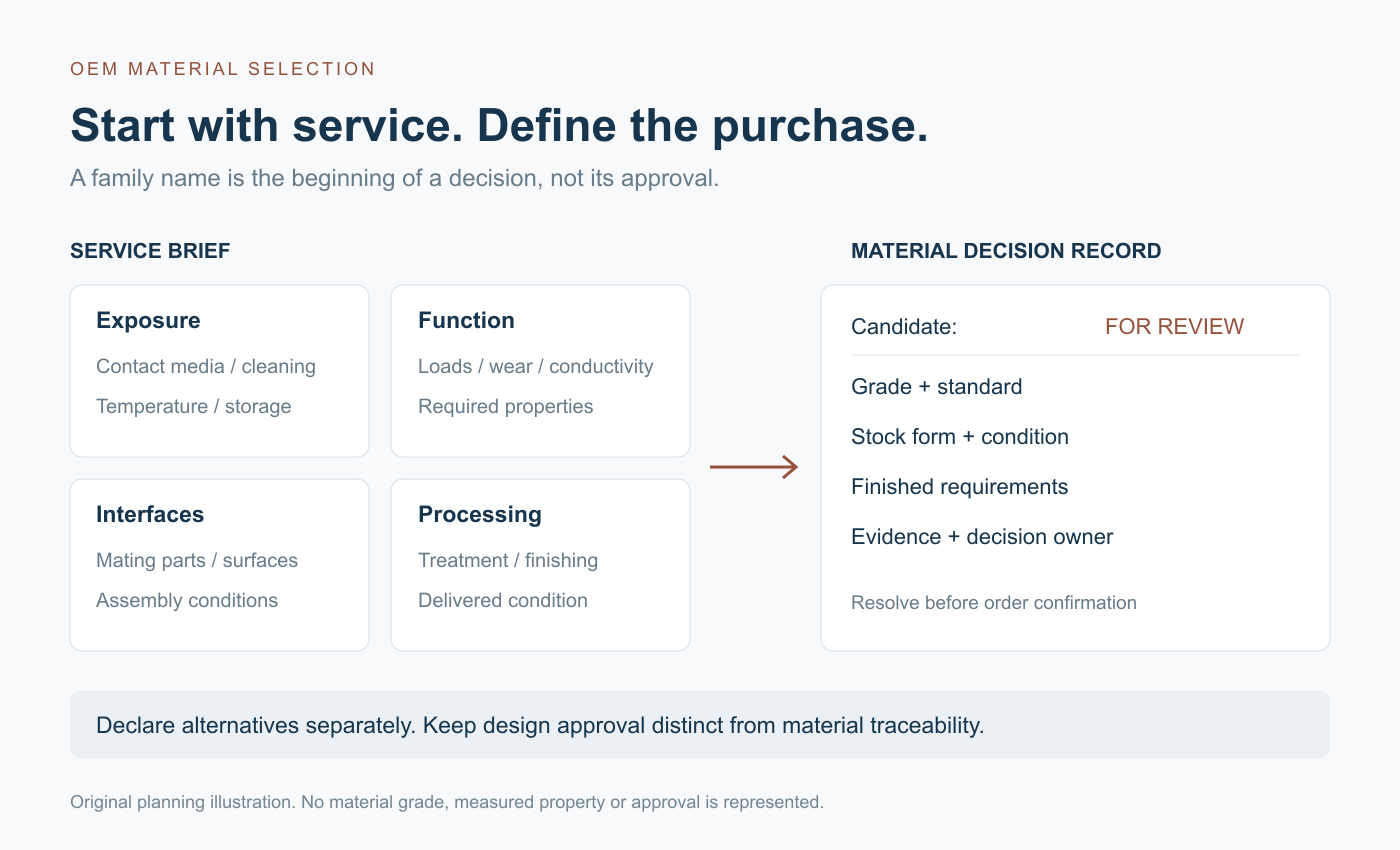
Two quotations can both say “stainless shaft” and still describe different purchases. The material grade, stock condition, treatment route and evidence may differ. Comparing their unit prices before resolving those differences can hide the cost of a part that does not meet its intended service.
For custom precision shafts and turned components, start with the application requirements, then identify the exact material specification. This guide helps buyers prepare that decision with their design owner. It does not approve a substitute or list grades guaranteed to be available from MICRO.
Write a service brief before choosing a family
Describe what the part contacts and does. Include the relevant operating environment, temperature conditions, loading, wear surfaces and mating components. Distinguish normal use from cleaning, storage and transport. An indoor application can still expose a part to a cleaning fluid or moisture during shipment.
Identify the consequence of a change. A locating pin, rotating shaft and electrically conducting spacer can share a similar outline while needing different properties. State which requirements belong to the material and which depend on the finished geometry, coating, lubrication or complete assembly.
Ask the design owner to separate mandatory requirements from preferences. “Prefer lower weight” gives a supplier a different task from an approved maximum component mass. Do not turn a preference into an unstated acceptance limit, or let an attractive machining price override a functional requirement.
Use material families to narrow questions, not to approve a grade
Family names are useful for an initial discussion, but they do not specify one consistent set of properties. Alloy composition and delivery condition matter, as does the form of stock used to make the part. Compare candidate materials against the same service brief rather than ranking families as universally best.
| Candidate family | Selection question | What needs an explicit specification |
|---|---|---|
| Carbon and alloy steels | Which strength, wear and treatment requirements apply? | Grade, product standard, stock condition and required finished condition |
| Stainless steels | Which exposure and mechanical requirements must be satisfied together? | Exact grade, condition, surface requirements and application review |
| Aluminium alloys | Which mass, strength, finish and joining constraints govern the part? | Alloy designation, temper, stock form and relevant properties |
| Copper alloys | Is electrical, thermal, wear or another behavior the priority? | Specific alloy and condition, with the applicable property requirements |
The table is a purchasing framework, not a list of approved alternatives. A family-level description cannot demonstrate that a replacement meets the drawing or operating conditions.
Treat stainless as a selection problem, not a corrosion guarantee
Outokumpu's corrosion tables explain that performance depends on exposure conditions and that laboratory data cannot guarantee actual service. Compare the relevant environment, not just the family name.
For the RFQ, describe the exposure as specifically as the design review requires: contact media, temperature, cleaning conditions and the relevant mating environment. Obtain an authorized material decision for that situation. Do not translate “stainless” into “will not corrode” or assume that a similar-looking grade is interchangeable.
Keep the finish and later processing in the discussion. A choice based on raw-material information alone may leave the delivered surface condition unresolved. Agree what the supplier is quoting and what evidence the purchaser will review before release.
Keep alloy and delivery condition together
The Aluminum Association's standards overview distinguishes alloy and temper information and different product forms. Include these identifiers when defining the required aluminium stock; “aluminium” alone leaves the purchase incomplete.
A clear material line should identify the designation, applicable product standard and relevant delivery condition. Ovako's Steel Navigator overview includes hardenability and machinability in steel comparison; family names do not settle those questions. Distinguish incoming stock from the required finished condition. Follow the heat-treatment guide for the separate process handover.
Avoid using a familiar trade name as the complete order requirement. Where an international or supplier designation is proposed, ask for the exact reference and the differences relevant to the application. A cross-reference table can start a review; it does not independently authorize substitution.
Compare machining cost without losing the service requirement
The Copper Information Center's brass guidance describes composition-dependent machinability and conductivity for selected brasses. It illustrates why a machining advantage must be considered alongside the properties required in service, not generalized to every copper alloy.
Ask suppliers to identify what a price change actually assumes. Is it a different alloy, stock condition, bar size, treatment, inspection scope or purchase quantity? Record the difference on the quotation instead of treating it as a like-for-like discount.
Compare the complete agreed route, including relevant finishing and verification. A cheaper raw material or faster machining operation does not establish the lowest cost for an acceptable delivered part. Equally, requesting a more expensive material without a functional reason can add cost without solving the real requirement.
Review a proposed substitute as a controlled change
Consider a fictional bushing order whose drawing names an exact alloy and condition. A quotation proposes “equivalent brass” because stock is available sooner. The outside dimensions are unchanged, but no comparison of the required properties or manufacturing condition is provided.
The purchasing response is to request the proposed designation and condition, identify the differences and refer the decision to the authorized design owner. Until that review is complete, record the offer as a proposed alternative. Do not silently copy its material description into the purchase order as though approval already exists.
If accepted, document the scope: part and revision, affected quantity, conditions, required verification and who authorized it. An approval for one order is not automatically permission for all future orders. The drawing and change-control guide explains how to carry that decision into production records.
Send a material decision record with the inquiry
Use this short checklist to make quotations comparable:
- Identify the part and current drawing revision.
- State the material designation, product standard and delivery condition, or mark the selection as unresolved.
- Describe service constraints and identify who owns material approval.
- List treatments, coating and finished-condition requirements that affect selection.
- Request the specific material documentation and any agreed verification.
- Require proposed alternatives to be declared separately, with their assumptions.
- Record which differences must be resolved before order confirmation.
Material selection defines what should be purchased. The material certificates and heat-traceability guide addresses the next question: how the delivered material and parts are linked to that requirement. A certificate matching an offered grade does not by itself approve that grade for the application.
Send the drawing and decision record through the quotation page or email [email protected]. Confirm feasibility, availability, documentation and any special evaluation for the actual part. See quality and inspection for the published inspection context.